
Two distillers take distinct approaches, but end up at the summit of the state’s spirits mountain
Written by Bob Johnson
Photographs by Michelle Johnson
Reviews by editor John Vitale
IT’S A blue-sky day in Washington wine country, the bright sunshine nourishing the grapes that are slowly evolving on the vines, destined for being harvested, crushed, fermented and blended into cuvees that will delight the palates of untold numbers of wine lovers.
Surrounded by rows of vines and with tasting rooms beckoning around every bend in the road, could there possibly be a better setting for a glass of bourbon, served neat, or perhaps a bourbon-based cocktail?
Wait. Bourbon? In wine country? What’s wrong with this picture?
Nothing, as long as the bourbon is being crafted by Browne Family Spirits or J.P. Trodden Distilling.
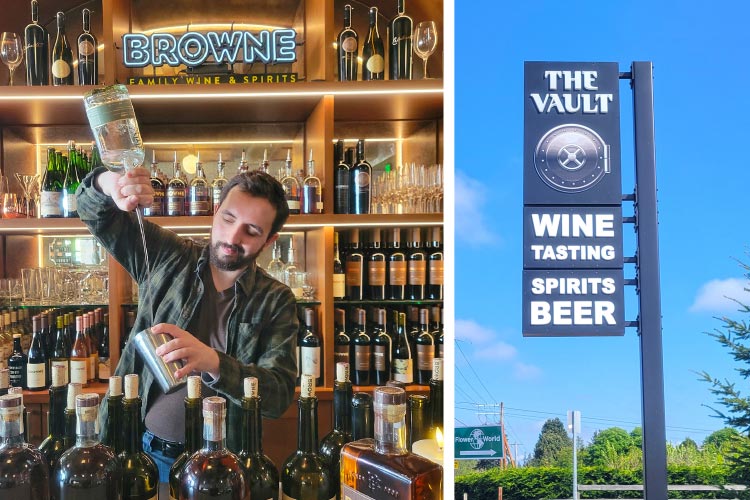
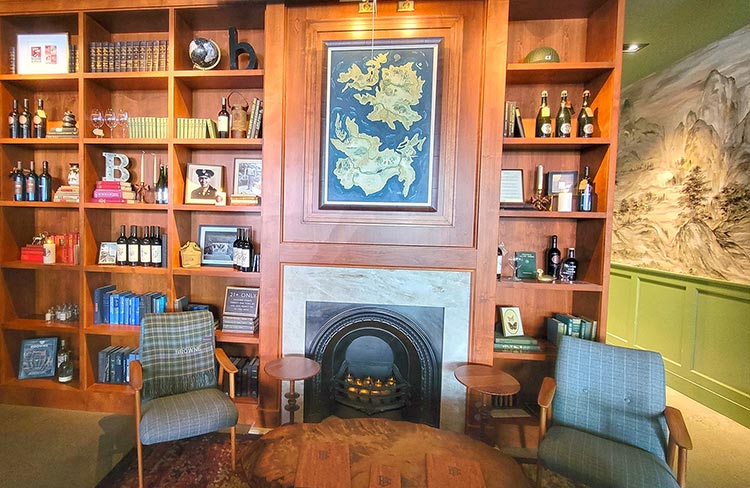
Andrew Browne purchased the Warrior Liquor distillery in Spokane in mid-2021, introduced the first Browne-labeled distilled products in October 2022, and now makes them available for tasting and purchase at the Spokane distillery as well as the six Browne Family Vineyards tasting rooms around the state.
Some might describe Mark Nesheim’s foray into making craft bourbon as the result of a mid-life crisis. In truth, it was more of a mid-life epiphany—a desire to take the lessons learned from a career in the restaurant business and do something for himself, his family and fellow bourbon lovers, rather than employers. He and his wife, Jennifer, decided to base their venture in Woodinville, surrounded by wineries.
Although the paths taken by Andrew Browne and Mark Nesheim were quite different, they converged at the same destination: the summit of Washington craft bourbon making.
Browne Family Spirits
Andrew Browne discovers that, even more so than making high-end red wines, crafting spirits is a passion of patience
Andrew Browne, the founder and proprietor of Browne Family Vineyards, has a clear recollection of when he had his first glass of “really good red wine.” The Spokane native was living in Southern California at the time and was poured a glass of Waterbrook Winery’s 1989 vintage Merlot.
“That changed my whole vision of Merlot,” he says. “It changed my whole vision of Walla Walla and of Washington State. That wine absolutely blew my mind,” and sparked an appreciation for Washington reds—not to mention whites and Rosés—that continues to this day.
Browne’s remembrance of the first bourbon he loved is far less clear.
“I don’t recall the brand,” Browne says. “But I’d gotten into the business when I was 21, so I started developing an appreciation for the stories and the flavor profiles very early. It was a unique opportunity. What I do remember is that I liked it stylistically and realized that whoever made it had put in time and effort and worked the quality angle.”
It was a far cry from the sweeter renditions one consumes “in the form of shots when you’re younger and sometimes drinking for reasons other than taste.”
It would take decades in the wine industry before Browne would decide to venture commercially into distilled beverages and founded Browne Family Spirits under the Browne Family Vineyards umbrella (and larger tent of the multi-brand Precept Wine & Spirits company).
After surveying the marketplace, he decided the best course of action would be to purchase an existing distillery with an outstanding master distiller. The distillery chosen was Warrior Liquor in east-central Spokane, which in mid-2021 was employing Kentucky native Aaron Kleinhelter to produce its spirits. Adjustments to the product line were made, and the newly christened Browne Family Spirits tasting room opened in Spokane in December 2022.
Many business owners like to bring in their own people when they purchase an existing business. Why did Browne decide to retain Kleinhelter?
“It’s betting on your horse,” Browne explains. “When you have a master distiller like Aaron who has grown up with it and knows the craft like the back of his hand—knowing how to take the raw ingredients and convert them, do the alchemy, get it all into the right barrels and age it for the right amount of time—you just let that horse run.”
It’s a lesson learned as Browne expanded his company’s wine empire.
“When you have a really good group of people, why would you not just rely on them to do their thing?”
That really good group of people on the spirits side extends to the Washington farmers who provide the agricultural products that contribute to each bourbon’s mash bill. Corn and wheat comes from Joseph’s Grainery in Colfax, malted rye from Linc Foods in Spokane Valley, rye from James Wahl in Ritzville, organic wheat from William’s Farm in Walla Walla, and malted barley from Country Malt in Vancouver. There’s no product waste, as any remaining spent grains after the alcohol is removed from the fermented mash is distributed as livestock feed.
“We’re dealing with a number of farmers who normally see their crop go into a co-op,” Browne says. “They did a really good job growing it, and then it kind of disappears. It just goes to a mill where’s it’s processed and doesn’t attach to anything.
“One of the coolest things I’ve seen with Aaron and the rest of our team working with these farmers is the pure joy it produces,” he adds. “Some of these folks are fifth-generation farmers, and they tell us they wish their grandparents could see the process. We invite them to the distillery so they can watch their product get turned into a mash and put into a barrel, then they come back to see and taste the finished product. It’s something they can attach their name to and know they helped create. That, to me, is incredible.”
Browne emphasizes that it’s not enough for his spirits to be Northwest standouts; they must compete with all bourbons—not only from Kentucky, but beyond America’s borders.
“We didn’t just slap a Browne label on the existing product, open our doors immediately and say, ‘Let’s go,’ ” he says. “We knew we had to make a quality statement out of the gate.”
That meant taking a different approach than Browne had come to know during his 30-plus years in the wine business.
“With wine, every vintage is different,” he observes. “You’re dealing with crop levels and what Mother Nature gives you, and making adjustments in cuvees, barrel selection, quantities and so much more. With spirits, the goal is to really nail a recipe and deliver on it year after year.”
Thanks to dual licensing from the state of Washington, visitors to Browne Family Vineyards tasting rooms can sample the company’s spirits, and visitors to the distillery in Spokane can sample the company’s wines.
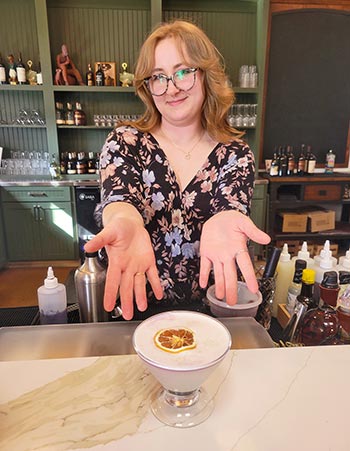
“It’s an opportunity to make all of our guests happy,” Browne says. “I have really bought into this whole idea that there’s alchemy in cocktailing—putting five, six, seven ingredients together. It’s like one plus one plus one plus one can equal a hundred. It’s absolutely amazing what a cocktail can be when it’s brought together by a great mixologist, and we showcase great cocktails in our tasting rooms.”
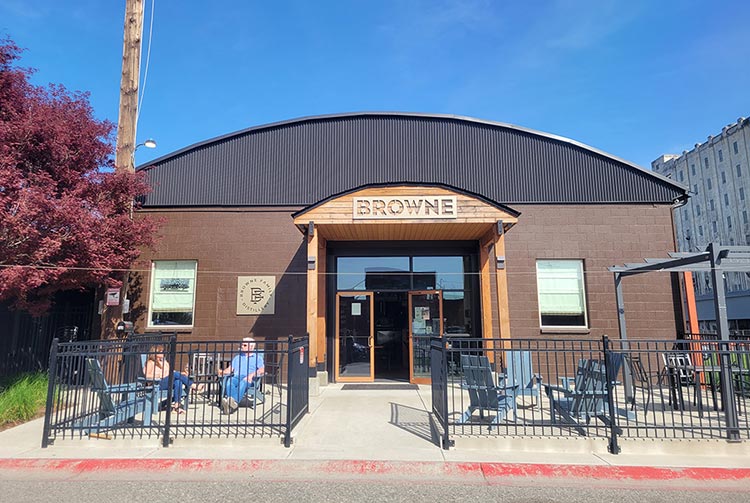
Browne Family Spirits has gained a solid reputation for quality in a relatively short period of time—from its bourbons, whiskeys, ryes, vodkas and gins in the general marketplace to its top-shelf Monogram products, Reserve bottlings and limited-edition Lab Series products that are tasting room exclusives.
“Aaron was already making so many things that were so good, the challenge was to pick the ones that would be our long-term benchmarks,” Browne says. “What’s really enjoyable when we nail a blend is the opportunity to taste it five years from now, ten years from now, and, knock on wood, 20 to 25 years from now and remember when we made it—how goose-bumpy that felt.”
Browne pauses a moment, then adds: “We used to think that it took a long time to get out high-end red wines. Making spirits is even more of a passion of patience.”
J.P. Trodden Distilling
His grandfather kept to a strict schedule as a mail carrier but distiller Mark Nesheim releases beverages only when they’re ready
The community of Chesaw (population: approximately 200) sits in Washington’s Okanogan County, less than a mile from the Canadian border. It began as a gold-mining camp in the late 19th century, and a post office was established there on January 13, 1898.
As was the case with so many boomtowns of the era, it didn’t take long for the town of Chesaw to go bust as frustrated miners left for greener pastures and more golden streambeds. But not everybody left, and during Prohibition, the post office employed a mail carrier who enjoyed drinking whiskey. Given Chesaw’s proximity to Canada where liquor had not been banned, the carrier had the opportunity to cross the border on a regular basis. When he did, he’d bring back a few bottles of spirits for himself and his buddies.
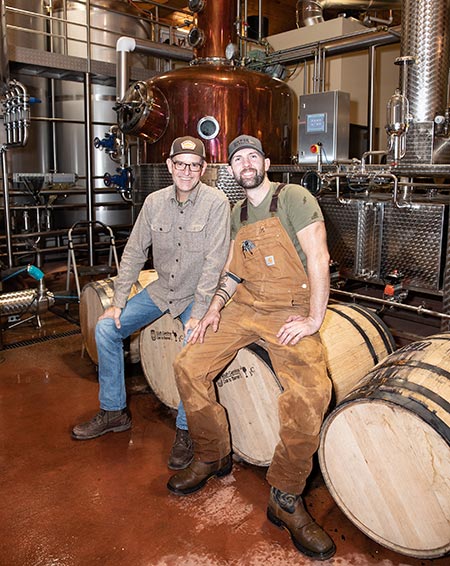
The mail carrier’s name was J.P. Trodden, the grandfather of Mark Nesheim. Today, Nesheim operates J.P. Trodden Distilling in Snohomish. Of his grandfather, Nesheim says with a smile: “He wasn’t bootlegging, but he was never dry, either. He was a pretty popular guy in Chesaw.”
Trodden worked what was known as the Star Route, and his house number in Chesaw was 5. A star, the word “Route” and the numeral “5” can be found on the labels of J.P. Trodden Distilling’s bourbon bottles as a family tribute. “We still own the little cabin he lived in,” says Nesheim. “This is our way of keeping his memory alive.”
Making craft bourbon—which he does today with his son, Dylan—was not on Nesheim’s radar for the first few decades of his working life, much of which was spent cooking, managing restaurants and overseeing restaurant groups. Anyone who ate at Seattle’s FX McRory’s restaurant prior to a Seahawks or Mariners game could have experienced Nesheim’s cooking or, at least, his influence in the kitchen. He spent 17 years there.

“McRory’s downtown was the biggest and busiest restaurant in the city during its heyday,” Nesheim recalls. “We had the world’s largest collection of bourbons at that time. That’s where I really developed my appreciation for great bourbon.”
As he was approaching 50, Nesheim was working for another Seattle culinary institution: the 13 Coins restaurants. In addition to its elevated dining, 13 Coins was known for its all-day breakfast.
“It was pretty much a 24/7 job, or at least it seemed like it,” Nesheim recalls. “So [my wife] Jennifer and I sat down and said, ‘Let’s try to find a different business.’ It was time to do something for myself.”
Nesheim says that several ideas were floated, and then Jennifer said, “What about distilling?”
The couple was thumbing through a magazine one night and came upon a full-page ad for Tito’s Handmade Vodka. Bert “Tito” Beveridge was known for accumulating stray dogs, and the ad depicted Tito, a dog and a bottle of Tito’s Vodka.
“My wife said, ‘Our dog is cuter than that dog, and you’re cuter than Tito.’ ” Nesheim recalls. “How could I disagree with that? The decision was made.”
Later, the Nesheims had an opportunity to meet Beveridge in Austin, the home of Tito’s Vodka.
“We told him that story,” Nesheim says, “and he told us he always wanted to make bourbon, but it was too much damn work.”
For Nesheim, plunging into bourbon making meant waiting three years from the time the venture began until the first product was released in 2013. The “alchemy,” as the art of bourbon making often is described, had taken place in a 1,600-square-foot facility in Woodinville, surrounded by grapevines and wineries.
“We became good friends with the winemakers and tasting room personnel,” Nesheim says. “They wouldn’t hesitate to recommend J.P. Trodden as a place to finish their day because we weren’t competitors.”
The distillery survived primarily by word-of-mouth and friendly-neighbor recommendations. Then, 18 months after opening, the debut Black Label release received a double gold medal at the World Spirits Competition. Just like that, J.P. Trodden was on the map.
Today, the same kind of camaraderie exists with J.P. Trodden’s winery neighbors at The Vault, a multi-unit production facility in Snohomish, in which the tasting room and distillery operation spans 6,700 square feet.
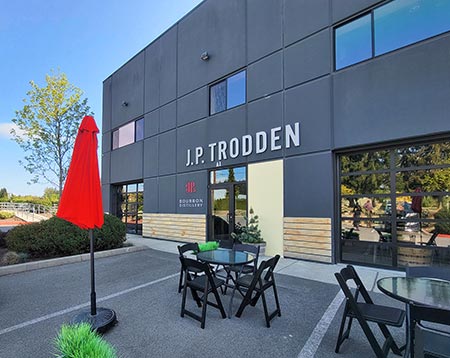
A return to Woodinville also is in the offing as J.P. Trodden has agreed to operate a tasting room at the new Harvest mixed-use development, which will include The SOMM Hotel & Spa, housing, retail, restaurants and numerous other tasting rooms.
Nesheim says he does not follow a strict aging regimen when it comes to his bourbons. The Black Label continues to be three years old when released. The Blue Label is a six-year “Reserve” offering that Nesheim says has become “the favorite of a lot of folks.”
Meanwhile, Nesheim had set aside two barrels from the distillery’s original location, and people kept asking him when he was going to release it.
“I just told them I’d decide when I decided,” he says. “When they were 10 years old, I decided it was time. In my opinion, it’s the best bourbon we’ve released.”
The “unofficial schedule,” for lack of a better term, calls for four or five releases per year, with about 240 bottles per release. Nesheim says he likes to have “a selection of younger bourbons for those who enjoy those nice, stout flavors, as well as older bottlings for those who prefer a smoother bourbon.”
How does Nesheim, personally, prefer to experience bourbon? It depends.
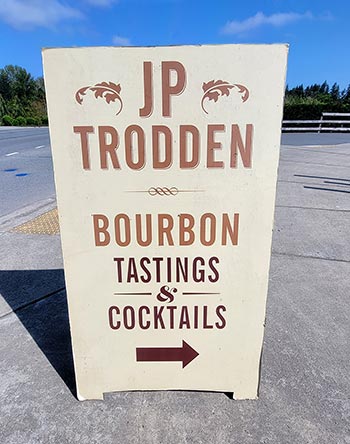 “Our aged bourbons have really pretty flavors that I like to drink neat,” he says. “I want to just sit back and savor those flavors. I might drink our higher-proof stuff with a rock (ice cube) just to mellow it a little bit.”
Nesheim says he also enjoys bourbon-based cocktails and drinking them with meals that “aren’t heavily meat forward.” With big, bold meats or barbecue, he says he’s more likely to go with a straight whiskey. And he says that he has been amazed by “how well the right bourbon goes with the right cheese.”
If there’s anything Nesheim learned in the restaurant business, it’s the importance of appealing to a wide range of flavor and texture preferences. Now that he has been away from it for a while, is there anything that Nesheim misses about those days?
“The camaraderie,” he says. “Before a game at the Kingdome, I’d have 20 or 30 cooks cranking out 500 or 600 meals. It was like being a member of a team. Everybody had to know what everybody else was doing, or they’d stumble over each other. But I’m also old enough to realize I would never want to do that again.”
Not when he can end his day at a more reasonable hour, raising a glass to his late grandfather with a pour of his own craft bourbon, served neat.
Bourbon Reviews
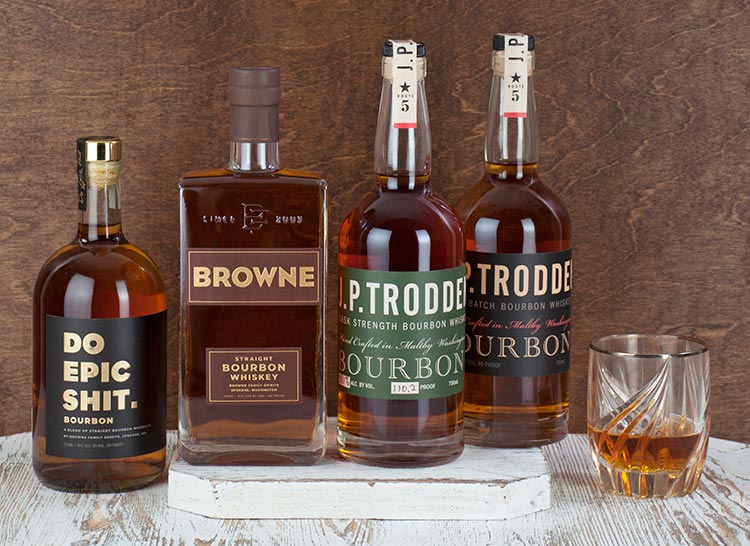
Browne Straight Bourbon Whiskey
94 pts.
Aged a minimum of two years in American white oak barrels, there’s a nice touch of warmth on the front of the palate. With a high-corn mashbill (82%) this instantly smooths with a rich offering of sweet vanilla and toffee, layered with hazelnut and oak details on the back end. 90 proof. $49.99 –JV
Browne Do Epic Shit Bourbon
93 pts.
This label was inspired by CEO Andrew Browne’s personal mantra for making every moment in life epic. Lush and pleasingly woodsy, it’s an inspiringly smooth blend of straight Bourbon whiskies, displaying gentle oak and a good range of macadamia nut and creamy coconut with undertones of vanilla. 80 proof. $44.99 –JV
J.P. Trodden Cask Strength Bourbon Whiskey
95 pts.
Aged a minimum of four years in new oak barrels, this was made from corn (70%) and winter wheat (30%) grown on a single Washington State family farm. Very smooth entry, with mellow notes of well-integrated oak that open to deep, rich flavors of caramel, maple, soft vanilla and toasted marshmallow. A buried note of almond nougat runs parallel to the long, warming finish. 110 proof. $95 –JV
J.P. Trodden Black Label Bourbon Whiskey
93 pts.
Aged a minimum of three years in new oak barrels, this Double Gold medal winner is a small-batch Bourbon that’s complex, filled with warm oak spice, followed by caramel, vanilla, anise and a lengthy finish aligned with black pepper and persistent wood spice details. 90 proof. $60 –JV
Tour & Taste
J.P. Trodden Distilling
The Vault at Maltby Tasting Room: 9206 200th St SE, Maltby WA
Ph: (360) 863-2190
www.jptrodden.com
Browne Family Spirits
Distillery & Tasting Room: 714 N Lee St, Spokane WA
Ph: (509) 413-1885
www.brownefamilyvineyards.com
Browne Bellevue Tasting Room: 10245 Main St, Bellevue WA
Ph: (425) 400-5505
Browne Tacoma Tasting Room: 2508 N Proctor Street #B, Tacoma WA
Ph: (253) 904-3066
Browne Seattle Tasting Room: 413 1st Ave S, Seattle WA
Ph: (206) 887-9463
Browne Walla Walla Tasting Room: 31 E Main St, Walla Walla WA
Ph: (509) 522-1261