
Syrah is favored among many leading winemakers for its chameleon-like charm. Could it become Washington’s #1 grape variety?
Written by Mark Storer
CALIFORNIA’S CLAIM to fame is associated with Napa Valley Cabernet Sauvignon, and Oregon is best known for Pinot Noir. Washington State, of course, does those varieties well too. However they aren’t the marketing juggernauts found south of the state.
But Syrah?
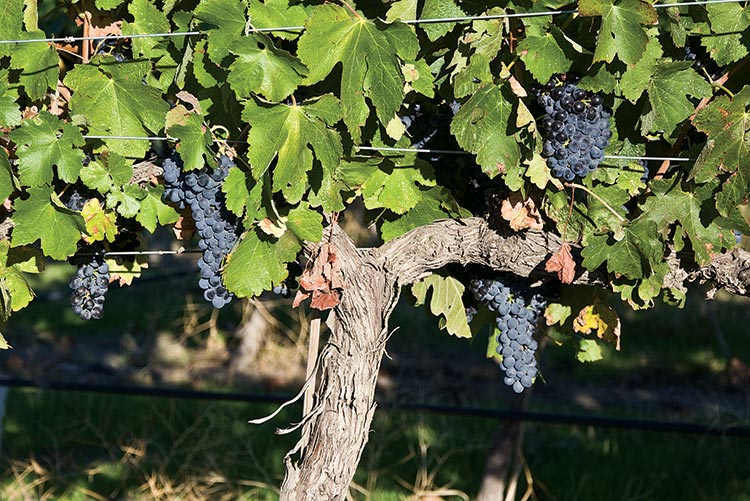
The noble Rhone grape is widely praised in Australia (known there as ‘Shiraz’) and in California. Washington winemakers and growers alike will use words like, wild, savage, and monster to describe it in its various stages. And, it is a chameleon in terms of styles and flavors.
Indeed, its inherent nature as it grows is vigor, and left untrained, it will be overcropped and lack any real freshness or character. But when managed correctly, Syrah in Washington has been compared by sommeliers, winemakers and winegrowers to the great Syrahs from California, Australia and even the Rhone Valley of France, where Syrah originates.
Syrah’s flavors, texture and structure can be coaxed in any number of directions making it a wine favored by winemakers in the cellar, but a bit harder to characterize in the way that California Cabernet or Oregon Pinot Noir are.
Early Popularity
If it is to be the wine grape of Washington, convincing the wine buying public of that might prove a bigger challenge.
Cabernet Sauvignon and Chardonnay currently hold the number one and two spots on vineyard acreage planted in Washington respectively. Syrah comes in third with over 4,500 acres planted throughout the state.
Dick Boushey who owns and farms Boushey Vineyard in the Yakima Valley near Grandview remembers the first time he tasted a Washington Syrah.
“It was an ‘88 Syrah that [grower] Mike Sauer and [winemaker] David Lake made, and I thought, ‘wow, this is so good! I want to grow this.’”
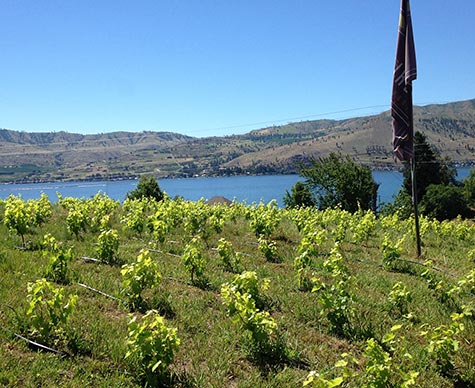
Sauer’s Red Willow Vineyard was the site of the state’s first planting of Syrah in 1986.
It became something of a passion for Boushey, who now grows more Syrah in his vineyards than any of the other 23 varietals he farms. Acquiring several clones, including some French vines, as well as Joseph Phelps clones from California, he sells a wide variety of Syrah grapes to customers like Cairdeas Winery, Rocky Pond Estate Winery and Avennia, among about 17 others.
“I planted my first block of Syrah around 1993,” Boushey says. “You have to have a winemaker that understands it. You can over-oak Syrah very easily and bury those flavors. That’s why I like the ones done in concrete.”
He’s referring to winemakers that ferment the grapes in concrete eggs or tanks, which allow a little less oxygen and a lot more extraction. “They bring out the best qualities of the fruit itself,” says Boushey.
Same Grape, Different Results
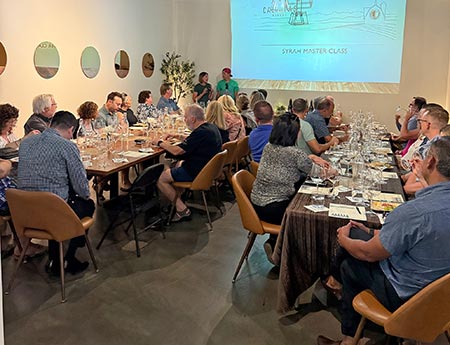
One couple who ferments their Syrahs in concrete, as well as wood barrels, is Charlie and Lacey Lybecker who own Cairdeas Winery in Lake Chelan. At their tasting room in a SODO industrial park called Urbanworks, the Lybeckers hosted a sold out seminar for 28 of their wine club members to learn about Syrah.
As the crowd took their seats, the Lybeckers were excited to delve into the nuances of the grape that they fell in love with.
Using fruit from Boushey, as well as other vineyards, including their own estate in Lake Chelan, the Lybeckers produce solely Rhone-varietal wines. They poured six Syrahs that evening in sets of two.
“The first wine is the exact same Syrah picked from the exact same vineyard on the exact same day,” said Charlie. “But it’s made in two different winemaking styles. One is a concrete, whole cluster fermented and aged wine, and the other is a de-stemmed barrel aged wine. It highlights how winemaking definitely influences the way the grape turns out.”
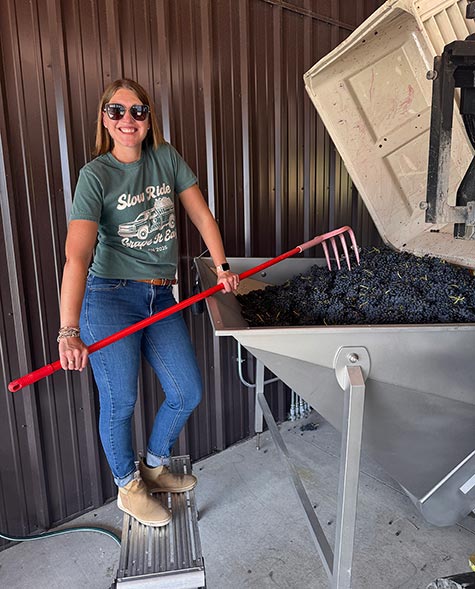
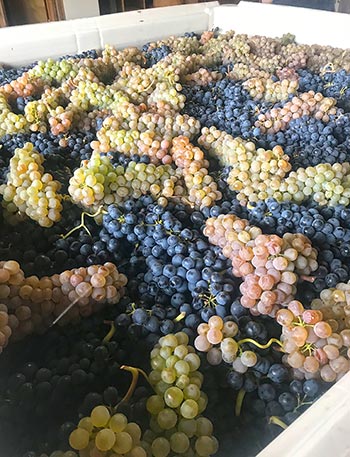
Cairdeas owner Lacey Lybecker rakes out a bin of Syrah grapes during crushHe pointed out both wines were from the 2022 vintage from Solaksen Vineyard. “You’ve heard that wine is made in the vineyard. There’s some real truth in that, but once it’s brought into the cellar, what we do to those grapes and how we age and ferment those wines has a drastic impact.”
The concrete fermentation creates a wine that is made in the style of Cornas, one of the prime Rhone varietal regions in France, a style the Lybeckers favor. Charlie underscored that point to make sure his audience understood.
“You can make Syrah anything you want it to be. It can be light and delicate, or big and bold and peppery,” he told the crowd of tasters.
“It all depends on your timing and your picking decisions. Those are crucial, and there’s a lot of winemaking decisions too, like vessel choices, yeast, how long you age, and all of the rest,” said Lacey.
A Sponge For Terroir
“Syrah is really a sponge for terroir,” says Elizabeth Keyser-Hadley, director of winemaking at Rocky Pond Estate Winery. “It’s why winemakers and sommeliers love it—because it can really translate the site.”
Wine consumers struggle with Syrah, however, because its characteristic for translating terroir means it’s a less consistent wine and it won’t be the same from vintage to vintage, or site to site.
“So the thing that makes it so great for a winemaker can be a problem for the average consumer,” affirms Keyser-Hadley.
Rocky Pond’s Syrahs are sourced primarily from Rocky Reach AVA and their Double D Vineyard there. “We like to be pretty hands off,” Keyser-Hadley comments about their Syrah. “It naturally wants to sort of peter off at around 24 brix. Capturing it at that sort of low end of the spectrum for alcohol also leaves it with a little bit more acidity on the palate. Then we like to co-ferment it with anywhere from five to eight percent Viognier,” in the Cote Rotie style. They also like to use concrete during the co-ferment, which allows a really long cold soak and coaxes more flavors from the fruit.
Keyser-Hadley uses no more than about 20 percent new oak. “I don’t want to cloud that fruit extraction with oak,” she says.
It’s a misconception that Syrah is malleable in the wine cellar and easier to make.
“Just because a plant grows well somewhere, that doesn’t mean that’s the place it should be planted,” she says. “Left unchecked, it will grow really well but it’s losing so much nuance and so much character if that happens.”
Yet if it’s managed properly, Keyser-Hadley points out, Syrah flavor profiles can range from gamey, meaty and even olive laden all the way to light, delicate, with blue fruit and a tamer mouth feel.
A Chameleon Grape
“It’s not one thing,” Chris Peterson, co-owner and winemaker of Avennia Winery and Liminal Winery, says of Syrah. “That’s what’s hard to teach the world—Syrah is not one thing. You can grow the same grape 25 miles apart and have two very different wines,” he adds.
Peterson produces two Syrahs under the winery’s Liminal label that are grown 500 meters apart and they’re quite different. Both are handled differently in the cellar, made with different clones, and grown on north and south facing hills. “One gets co-fermented with Viognier, and the other doesn’t, and we use different barrels for each. It’s just two different wines,” he says.
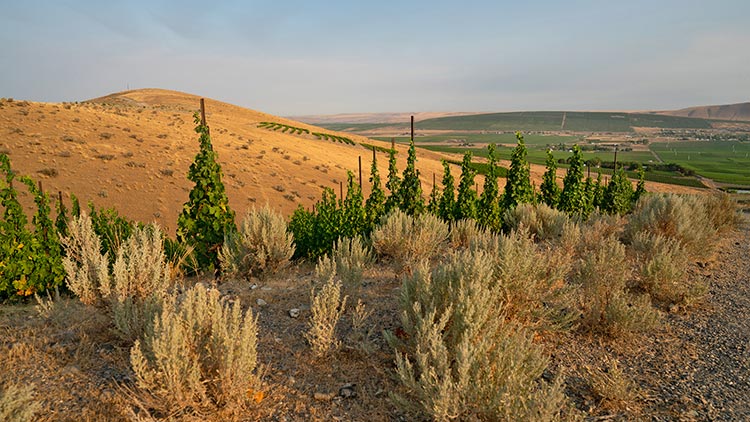
Forging through Syrah’s many attributes to bring out unique flavors, Peterson and his partner, Marty Taucher, have focused a lot of their attention on the grape under their Liminal Winery label.
While they make other wines as well (“who would only want to make one kind of wine?” says Peterson), all of the wine grapes from Liminal come from the WeatherEye vineyard on Red Mountain, including Syrah.
One of Liminal’s Syrahs is grown on a nearly 30 percent north-facing slope. “It’s very steep and it sort of mimics Cote Rotie, with those steep slopes where the vines struggle,” he says.
Peterson concedes that Syrah has a chameleon’s characteristics and grows well in a number of different places and microclimates that Washington has in abundance.
“Any wine can have a range of tastes,” he comments. “It’s the winemaker who brings out the character, and decides what the wine will taste like. We’ve explored Syrah more with Liminal, but there’s just not
a lot of energy for it in the market.”
Intention & Creativity
Is there a chance that Washington State will stake out a claim to Syrah the same way Oregon is synonymous with Pinot Noir? Peterson admits that getting people to understand that Washington State does many grapes well is a big enough challenge.
“I think we do world class Grenache in some places, for example. And a number of others,” but he believes the market is too fickle to introduce a Washington wine as the world-class example.
Keyser-Hadley agrees, but perhaps the point is more finely tuned.
It’s less about the Syrah grape itself, and more about the people in Washington who are dedicated to making it great.
“You have a group of winemakers who are passionate about it, and so the wine will be fabulous,” says Keyser-Hadley. “Because we’re approaching it with not just intention, but with creativity, too. But I’ll bet if we all wanted to take on Pinot Gris together, we would also make pretty kick-ass Pinot Gris as well.”