
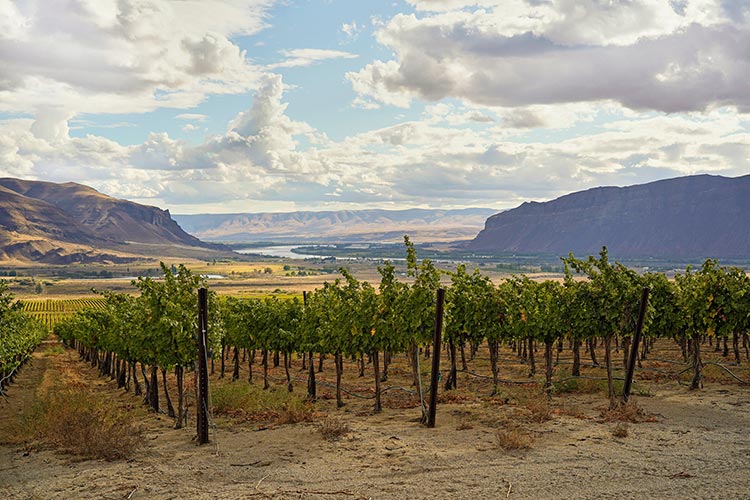
The number of American Viticultural Areas (AVA) within the state is rising. Beverly, Washington is the newest; it was officially designated as a wine grape-growing region on October 29, 2024 by the TTB (Alcohol and Tobacco Tax and Trade Bureau).
“Beverly, Washington marks our state’s 21st AVA, the last seven approved since 2020,” comments Kristina Kelley, executive director of the Washington State Wine Commission.
At 2,415 total acres, the Beverly, Washington AVA is one of the smallest appellations in the state.
Beverly, Washington AVA gets its name from an unincorporated town within its boundaries, which was established when railroad lines were first run through the region in the early 1900s.
The heat, in particular, makes the AVA desirable for growing red varieties. The vineyards are predominantly planted to Bordeaux varietals: Cabernet Sauvignon, Merlot, Malbec and Cabernet Franc. There are 400 acres planted under vines thus far, according to the latest agriculture report.
“All in all, it’s a place to grow robust red wines,” says Kevin Pogue, professor of geology at Whitman College.
“The Beverly, Washington AVA is a super-hot, windy location on the Columbia River in central Washington,” points out Tom Merkle, director of vineyard operations for Four Feathers Wine Services, an outfit that manages three vineyards within the AVA. “The vines produce very small berries with thick skins. As a result, the vineyards deliver intensely complex, rich wines that age well.”
The new AVA lies in central Washington, situated between the Royal Slope to the north and Wahluke Slope to the south. It is a sub-AVA contained within the larger Columbia Valley.
Not all wine grape-growing areas carry the official AVA designation. A region must first prove that it has distinguishing features that qualify it as an AVA. Kevin Pogue, who wrote the AVA petition for Beverly, Washington, says its defining characteristics are heat, wind, and soils.
Below is a quick breakdown of those elements that help define this particular terroir:
Heat: The appellation is one of the warmest in the state. Beverly, Washington receives a mere five inches of precipitation annually. This is among the lowest numbers in the Columbia Valley, with near maximum rain shadow effect.
Wind: The AVA is located two miles north of Sentinel Gap, a 1.5-mile break in the Saddle Mountains. Wind accelerates as it passes through Sentinel Gap and then slows. As a result, both average wind and daily maximum speeds are significantly higher compared to nearby Royal Slope. The wind keeps canopy and berry size small and contributes to thicker skins.
Soils: The appellation is located at the confluence of two major channels of the Missoula Floods. The floodwaters were slowed by the constriction of Sentinel Gap, causing heavier material to settle out. As a result, the soils of the AVA are extremely well drained. Well-draining soils generally give growers more control over water stress.
“Each new AVA is a sign of continued growth and maturity for the Washington wine industry,” says Kristina Kelley. “We look forward to seeing the Beverly, Washington AVA on labels shortly.”